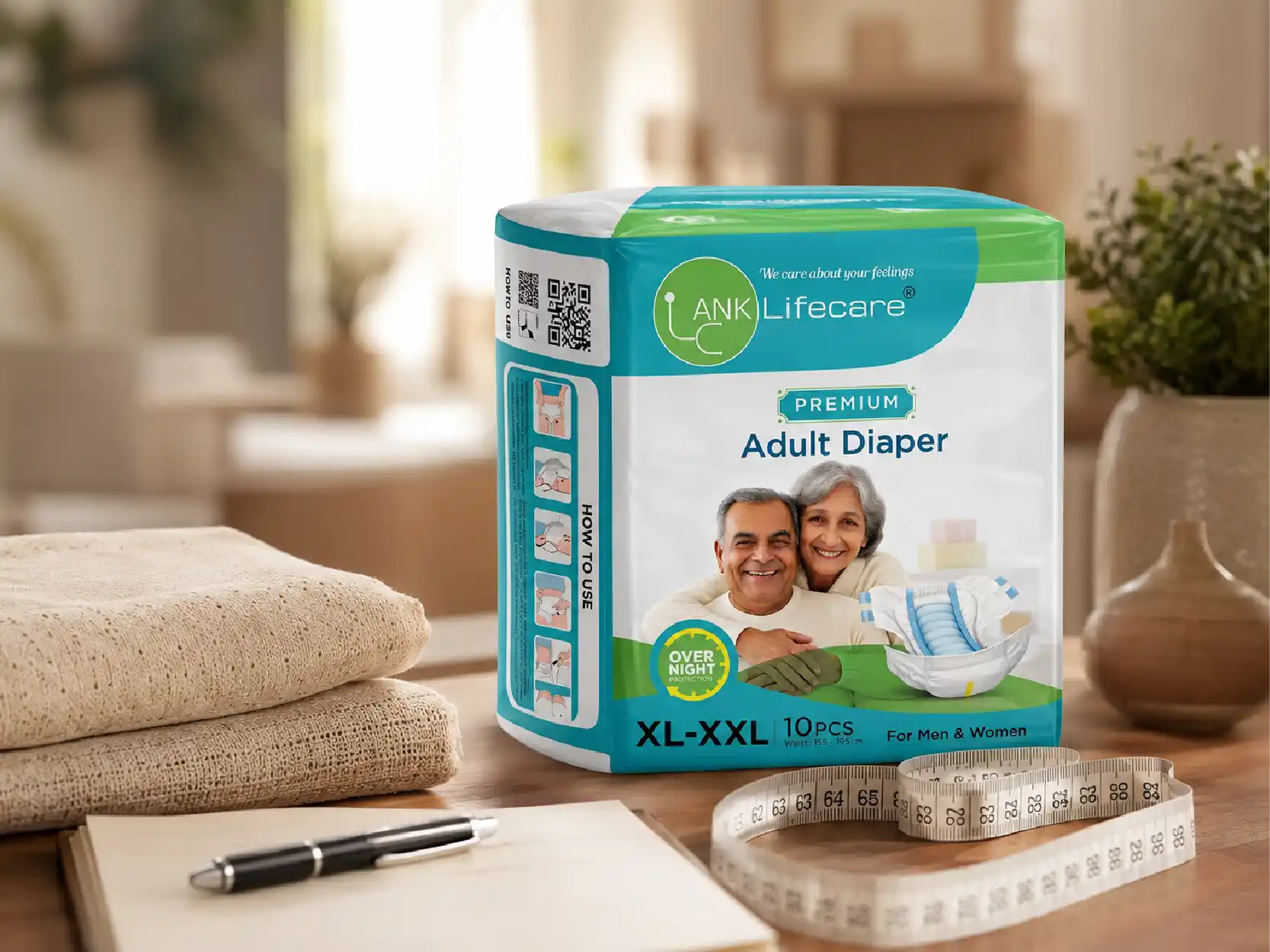

Before brand, before size, before price, there is one decision that determines whether incontinence care works smoothly in your home: the format. Adult incontinence products come in two main formats, tape-style diapers and pull-up pants, and they are built for different situations. Choosing the wrong one creates daily friction for both the user and the caregiver.
The short answer: tape style if the user is bedridden or changed by a caregiver, pull-ups if the user walks and manages changes independently. The rest of this guide explains why, and covers the in-between situations where the answer is less obvious.
How each format works
Tape-style diapers
A tape-style diaper opens completely flat, like a baby diaper scaled for adults. It slides under the hips of a person lying down and fastens with refastenable tapes on each side. The caregiver controls the fit precisely, can open the diaper to check the skin without wasting the product, and never needs the user to stand. LifeCare tape diapers come in Medium (71 to 112 cm waist), Large (112 to 155 cm) and XL/XXL (155 to 195 cm), priced Rs. 420 to Rs. 480 per pack.
Pull-up pants
A pull-up wears exactly like underwear: step in, pull up. The sides are stretchable for comfort and tear away for quick removal, so a change in a public restroom takes under a minute. Under normal clothing, nothing shows. LifeCare pull-ups come in Medium (60 to 110 cm), Large (90 to 140 cm) and XL, all at Rs. 480 per pack.
The decision table
| Question | Tape style | Pull-up pant style |
|---|---|---|
| User is bedridden | Best choice | Difficult to change |
| User walks independently | Workable | Best choice |
| Changed by a caregiver | Easiest | Harder |
| Feels like underwear | No | Yes |
| Fit adjustability | High, via tapes | Fixed waistband |
| Quick changes away from home | Slower | Under a minute |
Choose tape-style diapers when
- The user is bedridden. This is the clearest case. Changing happens in bed, and tape diapers are designed to be changed by rolling the user side to side. A pull-up cannot be put on a person who cannot stand without removing footwear and trousers entirely.
- A caregiver manages all changes. Even for users who can stand briefly, tape diapers give the caregiver control over fit and a faster, calmer routine.
- Skin needs frequent checking. Tapes open and refasten, so a thirty-second skin check does not cost a fresh diaper.
- Fit is difficult. Refastenable tapes accommodate bodies that fixed waistbands fit poorly.
Choose pull-ups when
- The user is mobile and independent. Most people managing light to moderate leakage need protection they control themselves, not a caregiver product. Independence is the whole point.
- Dignity and discretion lead the decision. Pull-ups look and feel like innerwear. For someone returning to work after prostate surgery or managing postpartum leakage, that psychological difference is everything.
- Travel is involved. Long bus journeys, flights, weddings and family functions all favour the format that changes fastest in a small restroom.
The in-between cases
The user walks at home but is unsteady. Start with pull-ups to preserve independence, and keep a small pack of tape diapers for illness days. Preserved independence usually pays back in mood and mobility.
Recovering after surgery. Recovery often moves through both formats: tape diapers for the first bed-bound days, pull-ups as walking resumes. Buying one small pack of each at discharge covers the transition.
Dementia care. This depends on the stage. While the user dresses independently, pull-ups feel familiar and reduce resistance. When changes become caregiver-managed, tape style becomes far more practical. Many families transition between formats and that is normal.
Nights versus days. Some active users wear pull-ups by day and a tape diaper with an underpad at night for maximum protection. Mixing formats is not wasteful; it is how experienced caregivers do it.
Whichever format you choose, the size must be right
Format solves the routine; size solves leaks and comfort. Measure the waist at navel level in centimetres before ordering either format, and read our size guide if the measurement falls between sizes. A correctly sized, correctly positioned product changed on schedule outperforms a bigger or more expensive one used wrongly, every time.
Still deciding? Describe your situation in one sentence on WhatsApp or call 1800-1212-665, and we will tell you honestly which format and size you need, including the products you should not waste money on.